
What Makes a Custom Kajabi Website Actually Custom (And Why It's Not Just Design)
Aug 15, 2026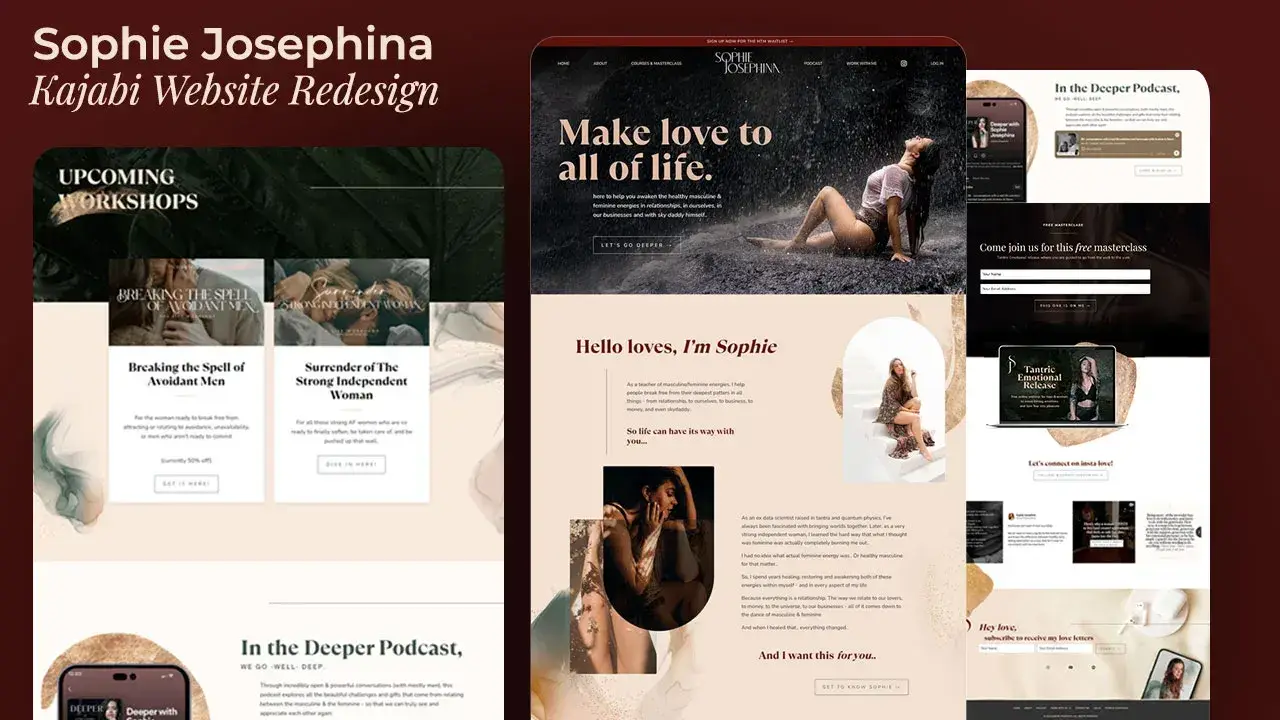

Dianne Empeynado
Vetted Kajabi Expert | Website Designer
Where sleek design meets bulletproof tech & support.
Last updated: September 12, 2026
A custom Kajabi website is planned around your specific business, content, structure, and technical setup, before any design work happens. A template with new colors and a logo swapped in is still a template, no matter what it's called.
A custom Kajabi website is one built around a specific business's content, structure, and technical setup, not a template with the logo, colors, and a few images swapped in. The word "custom" gets used loosely in this space, so it's worth being specific about what it actually requires: design, yes, but also platform knowledge and page-level strategy working together.
If you're a coach, course creator, or entrepreneur comparing Kajabi website designers right now, this is the question worth asking before anything else: what does "custom" actually include with this person?
Key Takeaways
- "Custom" should mean the structure and layout are built around your business, not just a template with your colors and logo swapped in.
- A Kajabi website needs three things working together to actually hold up: design, platform knowledge, and structure. Most providers only bring one or two.
- Page structure and planning are handled before any design work starts, separate from full copywriting or brand strategy, which is best handled by a specialist.
- Functionality testing, mobile optimization, and basic SEO setup come standard on every project, not as an upsell, and they matter: 53% of mobile visitors abandon a page that takes longer than 3 seconds to load.
- Custom code has its place, but I default to Kajabi's native tools first, so you can still edit your own site after launch.
- Real projects, like a template-to-custom redesign for Her Speaking Coach, show what this looks like when a site has outgrown where it started.
Jump to a section:
- What "Custom" Actually Means (And What It Doesn't)
- The Three Things a Kajabi Website Needs to Actually Work
- How I Plan the Structure Before Any Design Happens
- My Kajabi Website Design Process
- It's Not Just Design, Here's What Else Goes Into Every Project
- Built to Be Edited, Not Just Built to Launch
- Real Custom Kajabi Website Examples
- How to Know If This Is the Right Fit for You
- Common Questions About Custom Kajabi Website Design
What "Custom" Actually Means (And What It Doesn't)
A template with new brand colors and your logo is still a template. Nothing about the layout, the page order, or the way content is structured changed, only the surface did. That's not a criticism of templates; they're useful for getting a site live fast, and Kajabi builds good ones. But it means the word "custom" gets attached to a lot of sites that are really just re-skinned.
True custom work starts earlier than the visual layer. It starts with your actual content, your actual offers, and how someone should move through your site to get from "just found you" to "ready to buy." The design is the last thing that happens, not the first.
The Three Things a Kajabi Website Needs to Actually Work
Most Kajabi websites fall short in one of three places, not because the person building them isn't skilled, but because they're usually only strong in one or two of these:
Design. Whether it looks considered, cohesive, and like it belongs to your brand specifically.
Platform knowledge. Whether the person building it actually understands Kajabi's pages, settings, forms, domains, and automations, not just how to make something look good inside the builder.
Structure. Whether the pages are organized around how your business actually works and how a visitor should move through them, not just a generic page list.
A general designer working in Kajabi for the first time usually has the first without the second. Someone who only knows Kajabi's technical side but isn't a designer usually has the second without the first. Structure gets skipped by almost everyone, because it's invisible when it's done right and only obvious when it's missing.
How I Plan the Structure Before Any Design Happens
Before any design work starts, the real first question is: what does this site need to include, and in what order, for this specific business? A coach selling one-on-one calls needs a different structure than someone selling a self-paced course library. A membership site needs a different visitor journey than a single sales page for a live workshop.
This is where I map out what pages the project actually needs, what job each page is doing, and how someone should move from one to the next, before a single design decision gets made. It's structural thinking, not decoration.
Usability researcher Steve Krug's core argument, that a good page shouldn't make a visitor stop and think about what to do next, starts well before design. If a visitor has to pause and figure out where they are or what to do, the structure failed them before the layout ever had a chance to. That's exactly what this planning stage is meant to prevent.
To be clear about where the line sits: this isn't full copywriting or brand messaging strategy. If a project needs deep copywriting or a full marketing strategy layer, I bring in a specialist from my Kajabi Experts Circle rather than stretching outside what I do well. But the structure, what pages, what order, what each one needs to accomplish, that's mine to plan, every time, before design starts.
My Kajabi Website Design Process
The process stays consistent across every project:
Plan. Brand, content, references, goals, and page structure, gathered and mapped before design begins.
Design. Visual direction developed around your brand, audience, and the structure already in place.
Build. The approved design gets built directly in Kajabi: setup, configuration, responsive optimization, functionality.
Review & launch. Tested by hand, reviewed line by line, and launched working on day one, not fixed the week after.
A few specifics that come standard, not as an upsell: basic on-page SEO setup, mobile and page-speed optimization, and a Loom walkthrough after launch so you're never stuck wondering how to make your own updates.
It's Not Just Design, Here's What Else Goes Into Every Project
A beautiful website that doesn't function properly is still a broken website. A few things that get checked on every project, beyond how it looks:
Conversion structure. CTA placement and page flow built around how a visitor actually moves toward booking or buying, not just visual hierarchy for its own sake.
Technical correctness. Domain and DNS setup, mobile behavior, and page speed, the parts a visitor never sees directly but absolutely feels. This matters more than most people realize: mobile devices now account for roughly two-thirds of global website traffic, and according to Google's own research, 53% of mobile visitors abandon a page that takes longer than three seconds to load. A site that isn't optimized for mobile and speed isn't a minor gap; it's turning away the majority of the people who find it before they see anything else.
Brand-and-audience match. Design decisions tied to who you're actually trying to attract, not a generic aesthetic applied the same way to every client. That's why projects range from modern and minimalist to editorial, bold, or ethereal, the style follows the audience, not the other way around.
Fit with your business model. A site built for 1:1 coaching calls needs a different structure than one built to sell a course library or run a membership, the plan changes with what's actually being sold.
Ready for a website planned around your business, not a template?
Built to Be Edited, Not Just Built to Launch
Not all custom code is created equal, and inside Kajabi specifically, more of it isn't automatically better. I lean on Kajabi's native design tools first, and bring in custom code only where it genuinely improves something Kajabi's built-in settings can't do on their own, not as a default approach to every project.
Sophie Josephina, polarity teacher who works with masculine & feminine energetics in relationships, came to me after working with an agency that had built her Kajabi website almost entirely in custom code. The result looked polished, but she couldn't actually use her own website afterward, not to change a font, not to make a simple text edit, nothing. Every small update meant going back to the agency that built it.
The fix wasn't just a visual redesign. It meant rebuilding her site using Kajabi's own native tools wherever possible, so the things she'd actually need to update, fonts, copy, layout, were hers to manage again, not locked behind code only a developer could touch.
This is part of why ownership matters as much as design. A beautiful website you can't touch isn't fully serving you. Custom code has a real place, for details Kajabi's native settings genuinely can't achieve, but it should never come at the cost of you being able to run your own site.
Real Custom Kajabi Website Examples
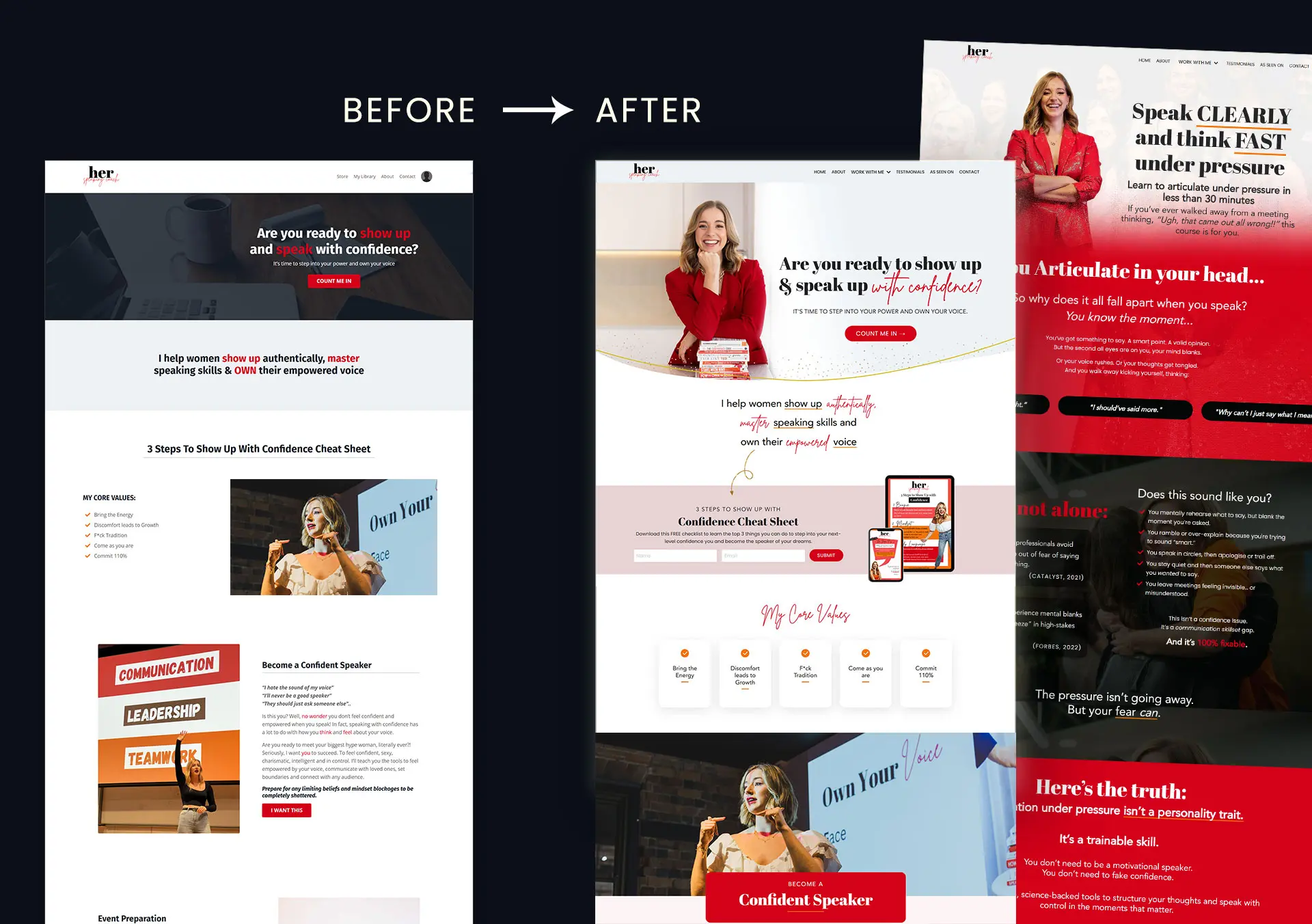
Industry Niche: Public speaking coaching
Project Type: Full website redesign, from off-the-shelf template to custom-built
Annelise McCarthy, Director and Founder of Her Speaking Coach, started with a Kajabi site built from an off-the-shelf template, functional, but not built around her specifically. When I came in to redesign it, the work wasn't a visual refresh layered on top of what was there. It meant rethinking the structure itself: what the homepage needed to accomplish, how her offers should be organized, and how a visitor should move from "just found her" to booking a session, then rebuilding the design around that.
That relationship has continued since 2022, usually project by project, a quick opt-in funnel here, a fix there, always at a fixed rate rather than hourly. For anyone looking for that same kind of ongoing, as-needed support, Kajabi Virtual Assistant support covers similar day-to-day help.
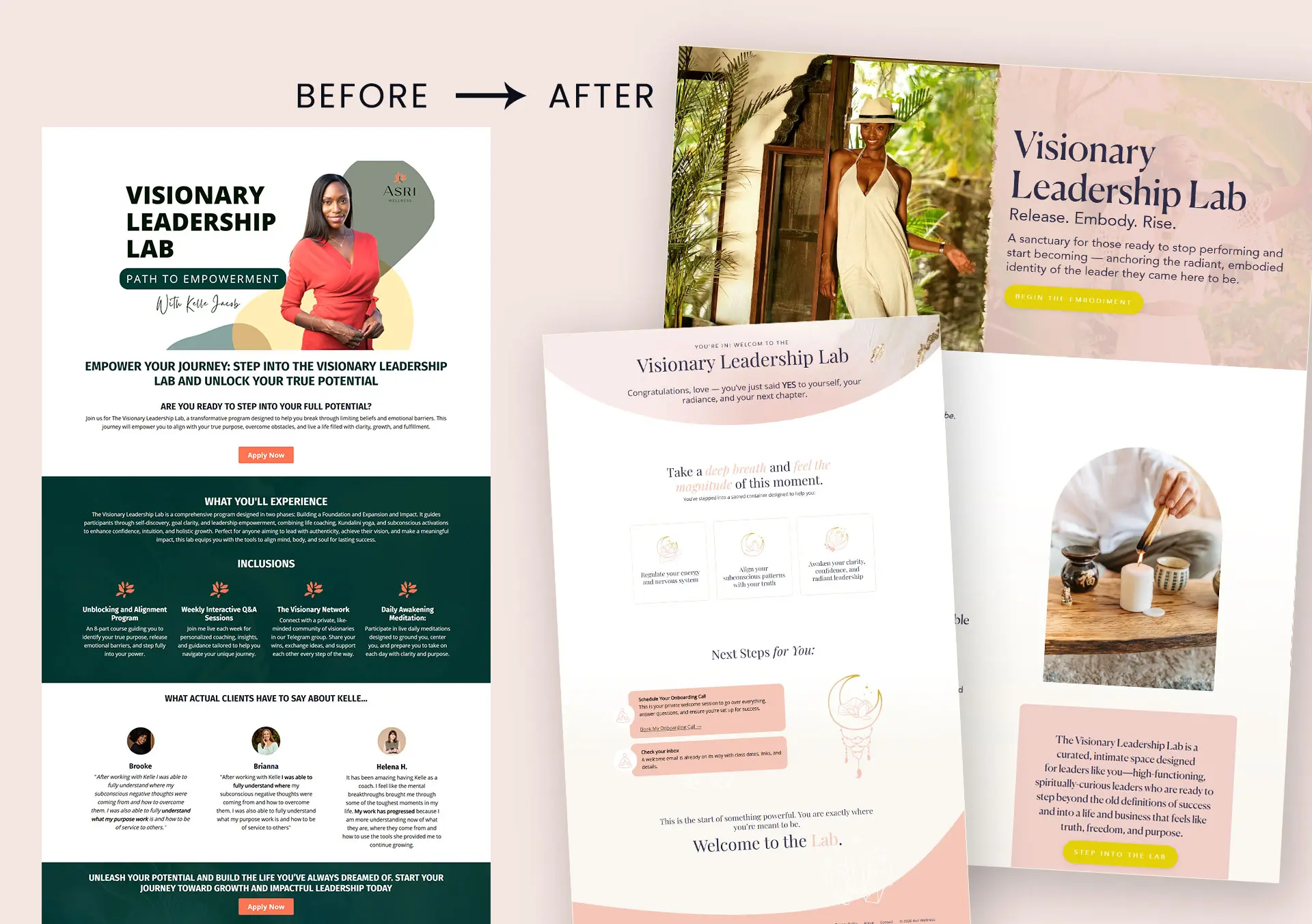
Industry Niche: Wellness coaching
Project Type: Website and individual funnel/offer pages, across five projects between 2023 and 2025
Kelle Jacob of ASRI Wellness worked with me across five projects between 2023 and 2025, spanning both her website and individual funnel and offer pages like Visionary Leadership Lab, each time picking back up as her business grew into something the previous build didn't fully reflect anymore. Every round, the focus stayed the same: design, UX, and flow that fit both her brand and where the business was headed next, not just a fresh coat of paint on the same structure.
That's the pattern worth noticing: the projects that go well aren't just design refreshes. They're structural catch-ups for a business that's already outgrown what it's working with. As designer and educator Chris Do, Founder and CEO of The Futur, has put it, strong branding isn't really about aesthetics, it comes down to strategy first. The same is true for a website: the parts that make it work happen before any design decision gets made.
Industry Niche: Career coaching
Project Type: New Kajabi website design
Theresa White of Career Bloom Coaching came to this project after a previous negative experience with another designer, which meant trust had to be rebuilt before any design work could even start. That context shapes how a project like this gets approached: communication has to be clear and consistent from the very first conversation, not just at the end when the design is ready to review.
"Dianne was an absolute gem to work with in designing my new website. After a previous negative experience, Dianne's expertise was a breath of fresh air. Her communication skills are top-notch, ensuring that all my ideas were understood and implemented perfectly. Her dedication and hard work are evident in the stunning result. The website she designed exceeded my expectations, showcasing her exceptional eye for design and attention to detail. The final product is something I love, and I am incredibly grateful for her work. I can't imagine working with another designer for future projects. Highly recommended!"
— Theresa White, Repeat Client
How to Know If This Is the Right Fit for You
This tends to be a strong fit if:
- Your business has grown or changed since your last website update, and the site hasn't kept pace
- You know roughly what you want but building it yourself in Kajabi keeps sliding down your to-do list
- You want one person or team handling design and platform setup, instead of managing a hand-off between two
It's probably not the right fit if you're looking for the lowest-cost option available, or if you need full copywriting and brand strategy built from scratch as part of the same project, those are better handled by a specialist first, with the website built around what they produce.
If you're weighing this against your own situation, the full Kajabi website design page breaks down exactly what's included, pricing, and the process, so you can see whether it matches what you need.
Common Questions About Custom Kajabi Website Design
What makes a Kajabi website "custom" instead of just a modified template? A custom Kajabi website is planned around your specific content, offers, and audience before any design work happens, not built by adjusting colors and images on an existing layout.
Do I need a copywriter or brand strategist before working with you? Not always. Page structure and planning are included in every project. Full copywriting and brand messaging strategy are outside what's included, and are best handled by a specialist, I collaborate with trusted copywriters and strategists in my Kajabi Experts Circle when a project needs that layer.
What happens if something isn't working after my site launches? Every project includes hands-on functionality testing and a pre-launch review before going live, plus a walkthrough so you know how to make your own updates. Reach out directly if anything comes up after launch. For ongoing help beyond the initial support window, regular updates, small fixes, day-to-day maintenance, monthly Kajabi Virtual Assistant support is also available.
Can you redesign an existing Kajabi website instead of building a new one? Yes. Many projects are redesigns of an existing Kajabi site, keeping the current setup and content where it still works, and rebuilding the structure and design around where the business is now. If your project involves moving from another platform (Wix, Squarespace, Teachable, etc.) into Kajabi as part of the redesign, that falls under Kajabi migration services, happy to talk through which one fits your situation.
Do I fully own my website after the project is done? Yes. Your Kajabi website lives inside your own Kajabi account, not a third-party platform or a system I control. Once it's built, it's yours: you can edit it, hand it to someone else, or move on without needing my involvement. There's no lock-in.
Ready for a Kajabi Website Built Around Your Business, Not a Template?
If your Kajabi website needs more than a new coat of paint, let's talk about what a custom Kajabi website design actually looks like for your business.
See what's included and start your project →
The Author
Dianne Empeynado is a Kajabi Website Designer and vetted Kajabi Expert known for designing across a wide range of styles: feminine, modern, minimalist, editorial, bold, professional, corporate, and everything between, with every site structured around how the business actually works, not just how it looks. She's worked with coaches, course creators, and entrepreneurs since 2017, and was formerly on Kajabi's own Technical Support and VIP Implementation team, so every design she builds is backed by platform-level technical accuracy most designers don't have, including complex platform migrations, advanced automation builds, and conversion-focused funnel architecture that generalist designers typically don't take on. She was ranked the #1 Kajabi Expert in Kajabi's official Expert Directory before it closed and its network migrated to Contra. For projects that need deep copywriting or brand messaging strategy, she partners with trusted specialists from her Kajabi Experts Circle rather than stretching outside her lane.
That combination, real design range, structural thinking, and technical depth, is why she's a top-rated Kajabi specialist on Contra, a Fiverr Vetted Pro, available on Upwork, and a member of the Experts Circle, a peer-vetted network of Kajabi professionals.
What began as a solo website design business has become a creative studio, built to support creators, coaches, and entrepreneurs through more stages of their business, while keeping the same thoughtful, personal approach that's always mattered. It's not about getting bigger for the sake of it. It's about being better equipped to serve the creators, coaches, and entrepreneurs who trust us.
See the range for yourself in the portfolio, or start your Kajabi project here.